Library

Case Studies by Category

Browse every company case study and business analysis we've published — filter by the kind of business case studies and lessons you want to learn.

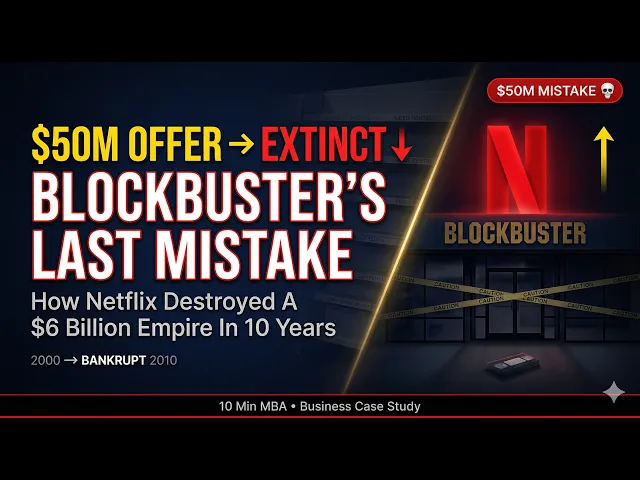
This library is hand-written, not aggregated. Each case study starts from primary sources — shareholder letters, founder interviews, court filings, and the business history books listed at the bottom of every piece — and is then rewritten to answer one question: what decision actually decided this company's fate? That's why you'll find the Netflix–Blockbuster meeting next to Amul's cooperative model and Zepto's 10-minute delivery bet: the industry changes, but the strategic patterns repeat.

New here? Start with the editor's picks below — they're the three stories that best show how we work. Prefer a theme? Use the filters for failures, brand wars, Indian startups, or fintech. Every piece is a 10-minute read, researched by a named author, and updated when the facts change.

Start here

Editor's picks

Advertisement
Showing 20 case studies
Nokia: From 40% Market Share to Almost Disappearing
▶
Business Failures6 min read

Nokia: From 40% Market Share to Almost Disappearing

In 2007, Nokia controlled over 40% of the global mobile phone market and was the most profitable phone maker in history. Within six years, Microsoft bought what was left of its handset business for $7 billion. The Nokia collapse isn't a story about iPhones — it's about how a company can be killed by its own operating system.

How Razorpay Beat PayPal, Stripe and Banks to Build India's $7.5B Payments Empire
▶
Indian Startups7 min read

How Razorpay Beat PayPal, Stripe and Banks to Build India's $7.5B Payments Empire

In 2014, two IIT Roorkee graduates couldn't accept online payments for their own startup — every Indian bank rejected them. So they built the payment gateway themselves. A decade later, Razorpay processes over $150 billion in annualised TPV, is valued at $7.5 billion, and quietly powers payments for 80 lakh+ Indian businesses including Facebook India, Swiggy, and the BCCI.

Xerox Invented the Personal Computer. Then It Gave It Away to Steve Jobs.
▶
Business Failures6 min read

Xerox Invented the Personal Computer. Then It Gave It Away to Steve Jobs.

In the 1970s, Xerox PARC invented the graphical user interface, the mouse, Ethernet, the laser printer, object-oriented programming, and the first personal computer — the Alto. Then Xerox handed the entire future of computing to Steve Jobs in a single afternoon for the price of $1 million in pre-IPO Apple stock. This is how the most innovative R&D lab in history made the biggest strategic blunder of the 20th century.

How Vijay Mallya Burned ₹9,000 Crore on Kingfisher Airlines
▶
Business Failures8 min read

How Vijay Mallya Burned ₹9,000 Crore on Kingfisher Airlines

Kingfisher Airlines launched in 2005 as India's first true 5-star airline — leather seats, in-flight entertainment, gourmet meals in economy. By 2012 it was grounded, by 2016 Vijay Mallya had fled to London, and Indian banks were left holding over ₹9,000 crore of unpaid loans. This is how an airline built to be a flying brand campaign collapsed under fuel costs, the wrong acquisition, and an owner who confused luxury with a business model.

The ₹3 Detergent That Forced HUL to Cut Surf in Half — Nirma
▶
Indian Business7 min read

The ₹3 Detergent That Forced HUL to Cut Surf in Half — Nirma

In 1969, a part-time chemist named Karsanbhai Patel started making detergent powder at home in Ahmedabad and selling it door-to-door at ₹3 per kg — one-third of Hindustan Lever's Surf. Within 15 years, Nirma was India's largest-selling detergent, had forced HUL to launch a cheaper brand (Wheel), and turned a ₹50,000 garage operation into a ₹7,000+ crore business empire. This is the textbook case study of how Indian frugal innovation broke an FMCG multinational on its home turf.

Zoho: How a Bootstrapped Indian SaaS Company Quietly Built a $1 Billion Empire
▶
Indian Startups7 min read

Zoho: How a Bootstrapped Indian SaaS Company Quietly Built a $1 Billion Empire

Sridhar Vembu started AdventNet in a Chennai apartment in 1996 with no venture capital, no IIT network, and no plans to chase the dot-com boom. 28 years later, Zoho serves 100 million users, powers 700,000+ businesses, and runs the world's most unlikely enterprise software company from a village in Tamil Nadu — without ever taking a rupee of external funding.

Advertisement

Common questions

Are these case studies free to read?

Yes. Every case study on this page is free, in full, forever. The site is funded by clearly labelled advertising and affiliate links to books we recommend — never by paywalling the core library.

Who writes the case studies?

Every piece is researched and written by Himanshu Agarwal, the site's founder and editor. Sources — shareholder letters, founder interviews, and business history books — are listed at the bottom of each case study, and our editorial policy explains the process in detail.

How is a 10-minute case study different from a business-school case?

Business-school cases are written to be discussed for 90 minutes; ours are written to be finished in 10. We keep the decision that mattered, the numbers that prove it, and the lesson you can reuse — and cut the filler, exhibits, and academic framing.

How often are new case studies added?

We publish a new long-form article every week and add company deep-dives regularly. Subscribing to the free Sunday newsletter is the easiest way to get each new piece.